Friday, November 25, 2005


Takod
by David Hontiveros

Chapter 1

[1] 1972.

She lies awake in bed, sweating, the house looming around her, like a crouching beast, oppressive. Summer has come early this year, the warmth like a herald for Semana Santa, an angel beating its wings, waves of heat radiating outwards from its divine being.

This is the time of death, and resurrection, though for the little girl, it is only the former she understands.

Death.

Death is when your father leaves one early morn, before the sun has even risen, leaves to make a living from the sea, a sea which betrays him, swallowing him whole, taking him into its cold, blue, bottomless throat.

Death, the little girl understands.

Resurrection, she cannot comprehend, a concept she cannot grasp, a word she cannot pronounce.

Outside, skeleton fingers scratch against the thin capis of her room’s window, as if the tree which towers over their home wishes entry. She stares at the window, at the vague shadows outside, not understanding why the tree is moving when she can hear no wind, when it seems too hot for any wind to even exist.

Or perhaps it is the wind from the angel’s wings.

(Her mother would disapprove of this fancy, so she pushes it from her mind.)

Then, as if summoned by her stray thought, a figure appears at her door.

Shadowed, silent, it is her mother.

She wishes her brother were awake, but he is not. He lies next to her, asleep, snoring softly. He looks exactly like her (for they are, after all, twins), and for an instant, she imagines it is she who is asleep, while her brother lies awake in the warm, humid dark.

Barefoot, her mother walks to their bedside.

She towers above them, her children; one asleep, the other, not. The little girl cannot see her mother’s face, cannot pierce the dark shadows which cloak it, like strands of long, ebony hair.

She watches as her mother leans down to plant a kiss on her brother’s smooth cheek. She remembers the Bible story of Judas, and again, pushes the thought away, mindful of her mother.

Then, strangely, impossibly, she watches as her mother, still on the opposite side of the bed, leans, and stretches towards her, somehow keeping her balance with both arms at her sides, as she moves to kiss her (and surely she can’t reach her, not with the bed so wide, not without having to lean over her brother).

She watches, frozen, her mother’s shadowed face moving towards her, dark hair like water, like spider’s silk, framing features she cannot see (and somehow, she knows, she would not want to see, even if she could).

And finally, finally, when her mother’s face is right next to hers, and she can feel the warm, fetid breath on her cheek, feel the feather touch of those dark strands of hair on her neck, she closes her eyes.

Then the wetness is on her mouth, and something slick finds its way past her lips, sliding along her tongue, something spherical and soft, tasting of mold and rot.

It slides down her tongue, her throat, and at last, she opens her eyes, to look upon the cold, blank face of darkness.


(TAKOD cover art by Wawi Navarroza)

Wednesday, November 02, 2005

Excerpts from Prologue 1 of "Parman"

Eric Ramirez holds his bright, shining future in his hand. In a perfume bottle, actually.

Estee-Lauder, he thinks. Or something like that.

It isn’t perfume in it now, of course. Not anymore. The liquid that’s in it is primordial. Seething with divine, miraculous power. Eric had seen what it could do.

He’d needed a demonstration, naturally. He wasn’t about to spend every single peso in his bank account (as well as every single dollar he’d stolen from work) on a few ounces of tap water in a used perfume bottle.

So he’d watched as the old man had taken the cat’s corpse, crawling with maggots and putrefaction, and flicked a single drop of the water on it.

It twitched.

Then it stood up, its head lolling. It was effectively blind, all that was left of its eyes leaking out of its sockets in a runny torrent. It was trying to meow, its legs shaky, in danger of collapse. It was making a strangled, liquid noise in the remains of its throat, a wave of maggots surging out of its mouth in a white, festering tide.

Eric was blinking madly, nodding his head, Yes. Enough. You’ve made your point.

And without a word, the old man raised the rusty shovel, and brought it down on the cat’s lolling, idiot head.

When the man in black smiles, Eric knows it is far too late.

“Our shadows have lives of their own. Did you know that?”

Eric begins to shiver.

“You dabble in the occult. Surely you know that many cultures, including some tribes in our archipelago, believe that a man has more than one soul.”

It is a shaking that borders on the violent, on a frenzy whose source, whose origin, is quite unknown to him.

“The soul that finds its shape and form in a man’s shadow is the most… unstable, the most volatile, of a man’s souls.”

Eric feels a tearing, as if his skin were being flayed from his body, and he screams, a long, drawn-out wail of agony.

Dimly, he realizes he is on the street, and the man in black towers over him, as does another man, a man too dark and hazy to look at, as if he has no features to boast of, though somehow, Eric senses something familiar about this man.

“Happy is he who speaks the tongue of shadows, for he can have an army at his beck and call.”

The man in black bends down, and reaches into Eric’s pocket. Feebly, Eric tries to stop him, but the other one—the dark man—takes hold of Eric’s wrist, and his grip is ice, is frost, and darkness, and Eric whines.

* * * * * * * *

PARMAN cover by Oliver Pulumbarit

PARMAN, CRAVING, and TAKOD are now available in Powerbooks. (Php120 each)

Find them in the Filipinina section of the store. You can also ask the people at the Customer Service Desk to help you look for them.


David's DHAMPYR got featured in the Philippine Daily Inquirer today: http://news.inq7.net/lifestyle/index.php?index=1&story_id=55260

Here's the excerpt:

'Dhampyr' by David Hontiveros

The gut: Nikolai is a dhampyr, born from a human mother and an undead father. In order to save his soul from restlessly wandering for eternity, he must find and slay his father. Nikolai’s personal journey leads him through a train wreck of memories, where the collision of the past and the present both haunt and strengthen him in his battles.

The stake: This comic bites you from the start and gets your blood humming. Its narrative is a vicious delight and the detailed artwork is darkly seductive and amazing. In its pages you will stumble into snippets from notable bands and icons from the goth movement you might want to look into.

Tuesday, October 25, 2005

What people are saying about David Hontiveros’ PENUMBRA novellas

“After reading (TAKOD), you may want to pack an extra flashlight, holy water, crosses, garlic, amulets, oracions, power objects and tools of protection spells on your next road trip. Oh, and you’ll want to make sure there is nothing wrong with the ignition on your car.” –Karen Kunawicz (Editor-in-Chief / Writer, Mango Jam)

“Dave came up with a harrowingly dark and creepy story (PARMAN) that kept me rooted to my seat, unwilling to do anything else until I finished it. He is one of those rare Filipino writers who I trust to come up with a satisfying and entertaining story each and every time. Can’t wait to read some more, Dave!” --Gerry Alanguilan, Artist/Writer Wasted, Humanis Rex

“A unique blend of action, dark fantasy, and high mythology, PARMAN is a wild ride amidst the forces of light and dark.” –Reg Ting, Editor, True Philippine Ghost Stories

“David Hontiveros delivers a penetrating eerie, well-paced thriller in CRAVING that unravels in a most ambitious and unique climax” --Jim Cliffe, Artist / Filmmaker, Tomorrow’s Memoir

“Even with out proverbial esoteric incantations, David Hontiveros unearths the gothis lyricism that lies hidden within the depths of traditional folklore with his dark, collective novella PENUMBRA—a literary trinity of lower-mythology stories set within the primordial, shadowy regions of the modern society. Be warned. These are not your usual `things that go bump in the night` stories. Remind yourself of proven rituals and prayers, and do not sit beside an open window. Garlic should come in handy, while guava leaves are good for the deep scratch wounds bleeding on your back.” --Paeng Sorillo

Monday, October 24, 2005

Chapter 2 of David Hontiveros'
Craving

The sun was just beginning to set, and Anne was on her way back to the house from her daily walk along the beach. Every other day of the week, Lester accompanied her, but today was Thursday, and Thursday was Clean-Up Day, so she went solo on Thursdays, careful to pack her cell phone in her canvas tote bag, in case of…

Just in case.

Anne sighed. She was so grateful for Lester, for his patience, his understanding. As difficult as this and the past two pregnancies had been for her, Anne knew it was doubly hard for her husband, who had no choice but to simply be there, by her side, unable to carry the whole burden on his shoulders.

Which she knew he would, without a doubt, without a moment’s hesitation, if he only could. But this was her burden, by virtue of gender and biology, this was hers, and she felt blessed to have Lester there, always, strengthening her resolve by his mere presence.

Anne smiled, a small, tender smile, as she walked along the dirt road leading up to the Doctora’s house, walked in the Daisy Duckzilla walk, as Lester had dubbed it. Anne had perfected a shuffling, shambling lope that was slow and awkward, but got her to where she wanted to go, safe, and in one piece.

“And that’s what it’s all about these days, huh, Junior?” she cooed, rubbing her stomach through the thin summer blouse she wore.

Dimly, she heard something.

She stopped, frowning.

There, off in the depths of the waist-high talahib to the side of the dirt road.

What sounded like a cat… yowling…

No. Not a cat. Not yowling.

Wailing. Crying.

“Oh, my God,” Anne whispered.

It’s a baby, she thought. It’s a baby that’s been abandoned, and it’s hungry and thirsty and how am I supposed to reach it? There could be snakes in there, and, oh! Snakes! And that poor baby! Lester!

And she began to dig through her bag, frantically. Then she noticed the crying getting louder, closer to her.

Frozen, she watched as the stalks of grass bent, and now, there was the sound of brittle snapping, and something (something?) crawled through the talahib, towards her, the crying definitely louder now, more insistent.

Anne backed away, slowly, her eyes transfixed, watching the swaying, the bending and snapping, marking the path, the trajectory.

And then the crying stopped. No winding down, no softening. Just a clean, dead stop.

But the grass was still being disturbed, upset by the movement, the resolute crawl of whatever it was.

Anne resumed the Daisy Duckzilla walk, a little faster now, pulling the cell out of her tote bag, the sound of crunching, snapping blades of grass deafening to her.

As she flipped her cell phone open, the giggling began, a high-pitched, lunatic sound.

She didn’t look back, didn’t wish or want to, she just kept walking, walking, her eye on the mango tree, which was yelling distance from the house, whispering the Hail Mary beneath her breath.

And though the giggling continued, an awful, manic noise, the sound of movement through the grass stopped, and Anne imagined blades of grass being pulled apart, eyes watching her, boring into her back.

But she still didn’t look back. She just walked, tote bag in one hand, cell phone in the other (in a skeletal, white-knuckled grip), leaving the giggling behind her, the Hail Mary still on her lips.

“… and blessed is the fruit of your womb, Jesus…”

And the giggling just went on, and on, and on…

Tuesday, October 18, 2005

A preview from David Hontiveros' CRAVING


Chapter 1

Lester awoke, and he could smell it.

The sea.

He smiled, stretching, positive the move was the right thing. And it wasn’t even like it was a permanent move, an uprooting of their lives in Manila. Just a vacation.

A vacation by the sea, to ease the stress and tension of Anne’s pregnancy. On her seventh month now, and both of them wanted so much to be optimistic, but here they were, cautious, careful. (The thrill of it though… enticing. To just up and start buying clothes and bottles and mobiles and rattles. But no. Not yet.)

Lester looked over at Anne, still asleep, her stomach bloated with life, with a Lester, Jr., healthy and whole. He had the almost irresistible urge to kiss the distended skin of her belly, but he reined in the urge, afraid he’d disturb her sleep.

He looked at his wife’s face, and saw peace there. Serenity.

During the day, awake, she would be her usual self, yes, with the occasional mood swings and cravings of the pregnant, but there would be a shadowed wariness in her eyes, as of a dog, slinking past a master it fully expects will kick it, though uncomprehending of its transgression.

They’d tried twice before, and both had been difficult, trying, and ultimately truncated pregnancies.

Anne wasn’t a particularly robust woman, and the infants had seemed ill-fated from the start: the first, without any forethought or consideration; the second, as a miserable consolation for the first one lost.

This one—Lester, Jr.—had been well-considered. Years had passed after that second miscarriage, and there had been many a midnight discussion in bed, in each other’s arms, before the decision, and the conception.

And now, now they were here, in the seaside village Anne’s O.B. Gyne, Doctora Teresa Milagrosa, hailed from, and they were holding their figurative breaths, waiting.

It was, in fact, the Doctora’s idea for Anne to be sequestered here, in her own home, so that her beloved patient could rest and relax and enjoy the process of motherhood. All was set, down to the specific nurses who lived in the village who could be called in when Anne’s time to deliver came.

Lester looked around the guest room, and was surprised to feel a strange level of comfort from his surroundings. It didn’t look like home, certainly not that, but it did look… lived in. He could see traces of himself in the room, traces of Anne, subtle marks—some, near-invisible—of their presence: a framed photograph here, a well-thumbed paperback there.

He looked out the window, the second floor room overlooking the dirt road which passed as the house’s front drive, and the gargantuan mango tree which marked the border of Doctora Milagrosa’s lot, its leaves and branches suggesting the intricate webwork of a vast maze, and for a moment, Lester allowed himself to be lost in its infinite windings, in its hidden depths and secret shadows. For a moment, Lester felt an utter, blessed calm.

Then, suddenly remembering today was a Thursday, Lester realized the Doctora was expected late afternoon tomorrow. (She’d long made it a habit to limit her Friday appointments to before lunch, so she could drive up to spend the weekends away from Manila.)

Lester got out of bed then, slowly, quietly, to start getting ready for the long day ahead, knowing he had to clean up around the house a little, if only to show their host that they hadn’t turned her home into a pigsty.

And Anne, alone in bed, stirred, her hand going to her belly, resting there, as if to shield her unborn child from some unseen, unknown menace.


CRAVING by David Hontiveros
Published by PENUMBRA (a Visprint imprint)
Cover art by Carlo Vergara

Tuesday, October 11, 2005

Que Horror!
By David Hontiveros

So it’s October, and Halloween’s a few weeks away, and I thought, Why not compile a list of the Ten Best Horror Films of the Recent Past?

The thing is, though there’s been a surplus of horror on the silver screen in the past few years, very few of these films are actually any good. Most are tired, formulaic retreads trundled out by Hollywood to provide instant (and ultimately, short-lived and ephemeral) gratification for the MTV generation.

Think about it: how many of the horror films you’ve seen in the past months can you actually still recall with any degree of accuracy, much less awe? How many do you think will be “classics” twenty years from now?

More so than ever it seems, Hollywood has been looking backwards, remaking not just the newest Asian horror film du jour, but horror movies from the heyday of the late 70’s and early 80’s. Evidence of this remake madness can perhaps best be seen in the list below, as two entries are actually remakes themselves; at least not all the recent remakes have been big fat losses.

Now, as any Top Ten list is always, in the end, a subjective thing, bear in mind: I haven’t watched every single horror film ever made, so, it’s entirely possible I may have missed a gem or two. Also, my definition of “horror” is pretty broad, ranging from the extreme grand guignol of splatterpunk, to the delicate atmospherics of quiet horror.

So, without further ado, and working our way backwards in time…

2005

Dark Water: armed with an impressive cast, Walter Salles delivers, doing justice to Hideo Nakata’s original, transcending the idea of horror as genre/marketing category, and diving into the realm of horror as emotion

The Descent: written and directed by Neil Marshall (Dog Soldiers), this is intense and takes no prisoners; six female friends on a cave exploring trip in the Appalachians discover the multiple meanings of the film’s title

The Ring Two: Nakata’s remake of his own Ringu II turns out to be a better film than both the original, and its English-language predecessor, a slick Hollywood horror film with intelligence and depth

Upcoming Film(UF): the remake of The Entity, the English-language remake of Jian Gui (The Eye), and the film adaptation of the savage feminist thriller, Out

2004

Dumplings: quiet horror from Hong Kong way, brought to us by Fruit Chan, this ultimately chilling tale of the price women must pay in our patriarchal society won a number of Asian films awards

Saw: dark and malevolent, with twists and flips running through its blood-soaked frame, this is the Se7en I wish Se7en had been

UF: Saw 2, though it’s directed by Darren Lynn Bousman, while James Wan (director of Saw) is helming Silence

The Village: horribly misunderstood by the critics, reviled by audiences thoroughly misled by the trailer, this is about the horror of the metaphorical beast lurking outside the security of hearth and home, and of the lengths some people will go to curtail its advance

UF: Lady in the Water; think Splash, M. Night Shyamalan style

2003

Janghwa, Hongryeon (A Tale of Two Sisters): the best I’ve seen from Korean horror, here, director Kim Ji-woon deftly mixes the supernatural with the psychological; currently being developed for an English-language remake

UF: the non-horror Dalkomhan insaeng

2002

Cabin Fever: the film with the meanest streak of black humor on the list, directed by David Lynch protégé Eli Roth, this one’s pretty visceral and gets you to shudder and cringe in all the right places

UF: Hostel, The Box, the remake of The Bad Seed, and the comedy Scavenger Hunt

Darkness: Jaume Balaguero’s English-language debut with Anna Paquin and Lena Olin in a haunted house in Spain; the cinematography, editing, and scoring are brilliant

UF: Fragile, with Calista Flockhart as a nurse suddenly faced with children whose bones become brittle for no apparent reason

Honogurai mizu no soko kara (Dark Water): arguably, Nakata’s best to date, this ghostly tale of love and abandonment is, of course, the basis of the first entry on this list

Parting shot: Nakata takes up two slots (and a third is for the remake of one of those films)! Also, half of the list is made up of films that find their roots in the Asian horror film scene.

Parting shot 2: the other 2002 horror release that just got edged off the list is Danny Boyle’s 28 Days Later, which reanimated the zombie film, paving the way for Zack Snyder’s slick remake of Dawn of the Dead, and George Romero’s socially-weighty return to the Land of the Dead

Saturday, October 08, 2005

... and not a drop to drink
(Diving Back into Dark Water)
by David Hontiveros

Hideo Nakata's Ringu opens with an image of the sea, waves moving in its ceaseless, eternal rhythm. His Hitchcockian psychosexual thriller Kaosu (Chaos) has its title card set against a shot of rain. Even his first Hollywood film, The Ring Two, opens with images of water. If opening images are anything to go by, Nakata seems to have a yen for water.

If there is any credence to this notion, then actually having the word in a film's title, and having it as a central image, might just have been inevitable.

Once again adapting material by Koji Suzuki, as he did with Ringu, Nakata opens Honogurai mizu no soko kara (Dark Water) with a credit sequence whose backdrop is filthy water, immediately submerging the audience in the medium used by the tale's supernatural menace to spread its sinister influence.

Dark Water revolves around Yoshimi Matsubara (Hitomi Kuroki), a separated single parent raising a child on her own (as was the scenario in Ringu). This time around, the child is a little girl, Ikuko (Rio Kanno), who finds herself in the middle of a custody battle. And while this domestic crisis is on-going, mother and daughter move into a new apartment, where strange incidents immediately begin to occur, as a ghostly force seems to have found a target in little Ikuko.

What follows is a film with more ambitious aims than Ringu, and one of its triumphs is that Nakata succeeds in hitting the bull's eye dead-on.

Though Yoshimi is just as harried a single mother as Reiko Asakawa was in Ringu, Yoshimi has abandonment issues from her childhood, that she is anxious she not repeat in Ikuko's case. Ultimately, this is a bitter irony, given what Yoshimi is forced to do to resolve the central dilemma of Dark Water. Also, Ikuko is a far more normal child than Ringu's Yoichi, who emanated an unsettling, other-worldly maturity in his demeanor.

Thus, it is clear that Nakata strives to people the story with individuals, to steep the tale in as much reality as possible, before the supernatural slowly seeps into its fabric. Structure-wise, he even does away with the gambit of the creepy opening set piece, as seen in Ringu. In fact, Dark Water could have been played with the tantalizing possibility that all the strangeness was taking place in Yoshimi's head, a ploy perhaps of her scheming husband to gain custody of Ikuko. This isn't Nakata's tack, however. But given that the story could have been told from this angle, pitting the tension of a natural, rational explanation against a supernatural, irrational one, becomes a testament to the authenticity of the scenario; of its reality.

While in Ringu, there was already a strong feminine presence, with Reiko and Sadako (and, to a limited extent, Yamamura), in Dark Water, the masculine presence is nearly non-existent, with only Yoshimi's ex-husband, a helpful lawyer, and a couple of other males playing very minimal roles. As far as Dark Water goes, the feminine is near-ubiquitous, which seems only natural, considering the film's central image of water.

In the Chinese belief system, yin ("shaded") energies are feminine, as opposed to the masculine yang ("sunlit"). Yin is also water and darkness, while yang is fire and light. Thus, yin is the negative part of the equation, while yang is the positive, sadly reinforcing the sexist belief of women being the weaker gender. A proper balance between these two forces is believed to be a prerequisite for the perfect life.

So perhaps it is this imbalance in Yoshimi's life that brings down the misfortune in the first place, but what Nakata ultimately does in Dark Water, consciously or otherwise, is to short-circuit the whole yin/yang balance, proving that a problem can be faced and addressed without the need of a male presence. Yoshimi is able to protect her child, her maternal love giving her the strength to pay the hefty price for Ikuko's safety.

Nakata is also able to present us with one of the hoariest scenarios in horror, the haunted house, and still make the goosebumps rise. And he doesn't even need to rely on outlandish production design, as in Jan De Bont's terrible misfire, The Haunting, to make the setting a character in its own right. All we have here is an apartment building, run-down and gloomy. A cramped, creaky elevator here, a water stain on the ceiling there, a grotty water tank on the rooftop, and presto, instant creepy haunted house.

Another nice touch in Dark Water is that, ultimately, the ghostly presence isn't truly a malignant one: it is only because of its loneliness that it reaches out to the living, unknowing (or perhaps, unmindful) of the harm it is causing in its wake. This isn't some raging spirit who sets off a spiteful curse that claims lives indiscriminately, by pure chance. This is a wraith with very specific needs and desires, paradoxically making it that much more malevolent, even if its motives aren't.

In the process of telling his story, Nakata is able to raise the issue of just how damaging to a child's psyche abandonment can be. Again, ironic given the story's resolution; as in Ringu, the mother is forced to do all she can to protect her child, though safety in Dark Water comes at a far greater cost. Here is an ending that could quite possibly be a far more cruel thorn than
Ringu's cold-blooded climax, due to the element of self-sacrifice present.

It is evident that Nakata intended Dark Water to be a horror movie with substance, and that it is. With the upcoming Dreamworks remake starring Jennifer Connelly and directed by Walter Salles (opening in the US on July 8), Dark Water follows in the footsteps of Ringu and Ju-On in making the global audience more keenly aware of the current rennaissance in Japanese horror cinema.
Seepage (Taking in Dark Water)
by David Hontiveros

Walter Salles' English-language remake of Hideo Nakata's Honogurai mizu no soko kara, Dark Water, is finally upon us, and it turns out to be the most subtle horror film made since Fruit Chan's Dumplings last year.

From a script by Rafael Yglesias (based on the Nakata/Takashige Ichise script, which was, in turn, based on the Koji Suzuki novel), Dark Water is the tale of Dahlia Williams (Oscar winner Jennifer Connelly), a woman in the middle of a messy custody battle with her husband Kyle (Dougray Scott of Ever After and Mission: Impossible II) over their six-year-old, Cecilia (Ariel Gade).

Forced by economics to move into a rundown apartment block in Roosevelt Island just outside of New York City, Dahlia's life quickly becomes harried and strained as the weight from her troubled childhood collides with the unsettling events that begin to take place in her new home.
Connelly (who is amazing here, just as she was in Darren Aronofsky's Requiem For A Dream) submits an astoundingly naturalistic performance, and is merely the tip of an intimidating and effective thespic iceberg, which includes John C. Reilly, Tim Roth, Pete Postlethwaite, and The
Practice's Camryn Manheim. Even young Gade as Ceci is impressive.

And the kudos aren't just for the performers. There is the man behind the camera who must be commended as well.

What Salles has managed to do here is take his talent for presenting the audience with real, textured, and nuanced characters-- as those in his Oscar-recognized Central do Brasil (Central Station)-- and apply that strength to the ghost story template, producing a masterful work with potent emotional impact.

Taking the themes of Nakata's original-- love and abandonment, and how both are not necessarily mutually exclusive-- Salles gives us a horror film that manages to transcend the idea of horror as genre/marketing category, and enter the realm of horror as emotion. Salles' Dark Water isn't about the long-haired ghost and the sudden cheap scare to get the audience to jump in their seats. It's about the slow realization that horror (or at least the seed of it, its potential) is, in a sense, all around us, and that horror can wrench the soul just as much as grief can. Salles isn't interested in goose bumps and the shrill shriek followed by nervous laughter; he explores dread and anxiety, the fears we all face on any given day: will there always be someone who will love us, or will we be ultimately left, alone and alienated?

Now, if you're beginning to think this may not be your idea of a horror film, maybe you should listen to your instincts.

Since my exposure to horror at an early age (one of the pivotal moments, watching Richard Donner's The Omen in the long-gone and sorely missed Rizal Theater at age 8), I have had the distinct privilege of exploring its breadth and depth, in both film and literature, appreciating the shock metal grue of splatterpunk and the delicate atmospherics of quiet horror, and everything else in between; all the ghosts and psychopaths, werewolves and vampires, zombies and cannibals, and other assorted things that go bump in the night, which caper and twitter and twirl madly in the vast spectrum of the realm of horror.

Karen Berger, editor-in-chief and mother of DC's Vertigo line of comic books once said, "Horror is a great backdrop or platform to explore a lot of relevant modern-day issues. Neil [Gaiman] and a lot of the Vertigo writers used horror as a genre device to explore deeper things." She also went on to talk about using horror as a backdrop "... to explore the world in which we live, and the real disturbing aspects about society and humanity, and everyday life."

Horror is meant to be unsettling; it is there to jolt and jostle us out of our complacency, to counter-act the anaesthesized delusion of the Hollywood feel-good movie, where everything is solved by a song-and-dance routine to some golden oldie, and everyone is smiling and happy before the end credit roll. Horror opens our eyes. It imparts truths to us, however harsh or bitter those truths may be, in the hopes that we may have epiphanies, so we may better our selves and our lives.

Hideo Nakata, one of the premier talespinners of horror today, clearly understands this. Apparently, Walter Salles does too.

So, if you've an open mind as to what the word "horror" could mean to you, then get out there and take Dark Water in. And if not, well, there's always the next horror film, complete perhaps, with long-haired ghost, ready to glide into the multiplex sooner than you think.

Tuesday, October 04, 2005

An excerpt from David Hontiveros' NATAKDAN


On the Friday that I see her at the town square, she is with Emma. Sweating, sticky, skeletal Emma, the ravaged crescent of a watermelon ring still in her hand.

She is wearing dark glasses, the kind fashionable women in Hollywood pictures wear.

Of course.

Naturally, she would wear dark glasses on a Friday.

She sees me and smiles, that quick flicker of ruby lips over perfectly white teeth, like the gleaming flash of a blood-soaked butterfly knife-- the balisong of my faraway youth.

My name is Lito. Hers is Lila. Or at least, she claims it is Lila. I doubt that is real name at all.

My six-year-old, Jenna, clamps her little hand about mine, squeezing, her tiny nails, digging into the flesh of my palm, reminding me of a beetle scuttling across my open hand, its legs pricking my skin...

Jenna is staring wide-eyed at Lila. My daughter knows as well.

She is as scared of Lila as she is of me.

That's good.

I turn Lila's smile, reveling in our conspiracy, enjoying the pain of Jenna's nails against my skin.


Read the whole tale in the first issue of STORY PHILIPPINES.
Now available in bookstores and magazine shops.
Php 120. 40-pages. Full-color.
Secrets, Mysteries, and Lies (Discovering Lost)
By David Hontiveros

An eye opens. A pupil contracts. A suited man, scratches on his face, awakens in a bamboo grove.

Thus do the mysteries of Lost begin.

Co-created by J.J. Abrams, creator of Felicity and Alias, Lost is the story of 48 survivors of a crashed airliner, who find themselves stranded on an island of menace and enigma. It’s been glibly described as “Survivor meets The X-Files,” and on the one hand, that’s an acceptable enough description, but on the other hand, is terribly reductionist; Lost is a show that could, potentially, be far more than either. Already, it’s been nominated for a Golden Globe for Best Dramatic Series, and took the second spot on Time’s Ten Best of 2004’s TV selection.

One of the best aspects of Lost is the manner in which it’s structured. Past the two-part Pilot, each episode does two things, and it does them well. First, each episode advances plot; second, it spotlights a particular character (or pair of related characters), showing us through flashbacks, who these people were before the crash, and the set of circumstances that led to their being on the ill-fated flight.

Excellent story structure is then wedded to sharp, astute writing (by a team of writers, many of whom have a Minor in Sociology) and one of the best ensemble casts working on television today. Though the show’s leads could conceivably be identified as Matthew Fox (Party of Five) and Evangeline Lilly (Kingdom Hospital), there are approximately 14 major characters, whose personal stories weave in and out of the bizarre events on the island as the episodes progress.

One of the beauties of Lost is that the mysteries aren’t limited to the island goings-on, but extend to these individual’s pasts, to the secrets of who they were before the crash afforded them a chance to start again, a theme central to episode 3, “Tabula Rasa.” These are people who suddenly find themselves in an extreme situation where society needs to be rebuilt, a situation where sometimes, the old rules just don’t apply, where the old allegiances no longer have any bearing.

This is, then, the Survivor aspect of the show. (And, if it’s one thing I can thank Survivor for—which has long overstayed its welcome—it’s for whatever sort of role it may have played in the development of Lost.) The group dynamics, the in-fighting, the cliques, the friendships, rivalries, and enmities—which is, I imagine, where the Sociology Minors come in handy.

What’s more, these are complex characters, who ultimately belie the façade we readily see: Jack, the responsible doctor and reluctant leader; Kate, the self-assured, capable heroine; Sawyer, the redneck scoundrel anti-hero (Josh Holloway)—they, and the 11 other main characters of Lost, prove, sooner or later, to be far more than what they seem, which is, of course, the way it is in real life. And it’s in that divide, at some point between who we really are, and who others think we are, that we can find the best true self we can be.

This complexity of character is achieved with the solid union of script and performance found in Lost. And though the most familiar face here will probably be that of Dominic Monaghan (Merry, from Peter Jackson’s Lord of the Rings trilogy) as Charlie, member of the one-hit wonder Driveshaft, the other ensemble players are nonetheless extremely talented and skilled in their craft.

Reportedly, Yoon-jim Kim, who plays Sun, originally auditioned for the part of Kate, and though she wasn’t right for the role, Abrams and company were so impressed by her, that the character of Sun was written into Lost, expressly for her. (Also, the role of Charlie was originally a 40-plus year old has-been rocker, but because of the impression Monaghan left on Abrams, was re-written to better fit the young actor.)

That tangible reality of these characters’ humanities is then off-set most effectively by the weirdness of the island, the X-Files part of the equation. Clearly though, Lost is a far more ambitious undertaking than The X-Files. Whereas The X-Files was episodic in nature, with its string of mythology episodes running through it, Lost is one continuous story, Season One chronicling the first 40 days on the island. Its mysteries are connected to the island, and they steadily build, week in, week out. Ultimately, the pay-off is going to have to be huge, given the high stakes of the set-up. Lost cannot afford to fizzle the way The X-Files did towards its end, not the way it’s building itself up.

Luckily, J.J. Abrams seems to be on a roll. With the modest success of Felicity, and the monster hit of Alias under his belt, he’s gone on to help create a brilliant melding of strangeness and humanity in Lost, a show that is quickly gaining popularity and a loyal following, a show about mystery and reality, and the mercurial point where both converge, a place where we get the chance to see the best (and worst) in ourselves, as individuals, and a collective race.

Monday, June 13, 2005

On the Verge
Karen Kunawicz
Mirror Weekly, June 3, 1996

It’s been about a year a three months since the first time I featured anything that had to do with Alamat (“C For Yourself”, co-written by Budjette Tan). Alamat, for those who have just joined us, is the name of an “umbrella organization” of a group of local comic book outfits which include Memento Mori, Virtual Media, Cheap Thrills Comics, Powerhaus, Deranged, etc.

Since Budjette wrote about Comics 101, I’ve gladly let Memento Mori and Powerhaus take over the pages of “On the Verge”. Lately, I’ve been approached by a number of readers who say they’re quite interested in the local (and foreign) comic book scene. In fact these last few weeks most of them have been talking to me about comics than bands, music, vampires, and all that gothic stuff.

I met David Hontiveros (a wise weaver of tales) through Budjette last year and his name should be familiar to you by now since I’ve let him take over a couple of times as well on topics that deal with comics and dark fantasy-slash-horror. Last week I said that I’d feature an article of his, on how to write stories but I figured I’d let this one go ahead. It’s a bit of an update on what Alamat has been up to lately and it’s also a bit of glimpse into what it’s like to be part of that group.


Life in the Trenches
By David Hontiveros

ALAMAT 101
It all began three years ago, after a series of phone calls that would, quite literally, change the course of my life.

“It” refers to my involvement in the creation of comics, in the actual spinning to tales, of committing dreams and visions and ideas into panels and pages, for all the world to see.

Now I am smack dab in the middle of a group called Alamat, whose ongoing mission is to explore strange new worlds, to seek out new life and new civilizations: to boldly go where no man has gone before. (Actually, it’s to create quality comic books , but hey, who can resist those immortal lines?)

Life in Alamat is… how do I put it? It’s different. It’s a constant round of chaos, and frenetic whirlwind of activity, as we, in now particular order, write and draw comics, have them printed and distributed, talk with retailers, set up exhibits, conduct workshops, and for those of us who are not participants in the 9 to 5 rat race, attempt to do some work on the side to help support the comics end of our lives.

If it sounds like a horrifying daunting amount of work, that’s because it is! Take my word for it, our Circadian rhythms are so out of whack, we’re probably immune to jetlag now. Slit our veins open and Coke and coffee would come pouring out.

This should prove, beyond the shadow of a doubt, how dedicated we are to our art—we’re willing to undergo severe psychological changes, radical body alterations, in order to get our comics out there!

Alamat is now about a year-and-a-half old, and in those 18 months, we’ve come quite a long way, being the subject of newspaper articles, TV interviews, and student papers. We’ve had exhibits and talks at universities, store tours and signing sessions.

But at the heart of all this are the comics we create, the stories we wish to share with the world. Whatever else we do, whatever stories we tell is in the service of comics lovers. That doesn’t make these activities any less interesting. So here’s a quick sampling of what we’ve been up to recently.


EXHIBITIONISTS AT PLAY (AND WORK)

Early February saw Alamat at U.P. (the University of the Philippines) during F.A.(Fine Arts) Week for an exhibit. There, we were greeting enthusiastically, approached by fans of our work, faculty members who gladly extended their assistance as resource persons for our various titles, as well as the plain curious.

At the exhibit, we were also treated to an initial glimpse of the work of other aspiring comic artists from U.P., among them, a talented bunch called Block Comics, whose flagship title, AGIMAT, will see print in the coming months. (Ian Sta. Maria, artist for Agimat has done inking work for Batch72, an upcoming Alamat title. Ian’s artwork is clean and sharp so watch our for Agimat.)

More recently, we spent consecutive weekends setting up exhibits in two of Manila’s nightspots. At first, we discovered the vast potential some Alamat members have in the pop music industry. (If ever out comics go belly up, we can just market the hell out of Eric and Arnold-- who have photogenic qualities for pop album covers-- and Dino-- who has the showmanship for it. To quote Captain Katarungan, “Trust me, they are the best.”)

The second exhibit was just as memorable. Along with Karen and Belle and Trish and Lara, we talked about The X-Files and danced the night away – mostly to tunes I was totally unfamiliar with (All the better to work up an appetite fro Ali Baka’s shawarma- - Karen). A high point of the evening for me was dancing to Pulp’s brilliant “Common People.” (If you were there, I was the madman singing along with the Voice of Today’s Disenfranchised British Youth, Jarvis Cocker. “I wanna sleep with common people like you…”) It’s too bad they had to play Bjork’s “Hyper-ballad” when we’d already abandoned the floor.

It was also at this exhibit that I discovered, much to my surprise, that I was now a “pop enforcer.” Cool. I’d never been called that before. Now I know how to answer people when they ask, “But what exactly do you do?”

I’ll give them a knowing grin, a patented double-thumbs-up-with-pointing forefinger, and say, “I’m a pop enforcer.” That’ll stump `em!


SUMMER SCHOOL
The hear pounds and stifles, the air thick and muggy, a dry malevolent wing that scours the land and fries brain cells as if a desert jinn has migrated to the Far East and found the change of scenery quaint.

In the midst of this meteorological oppression, Alamat holds its first ever Comic Workshop at Claret School in Teacher’s Village. With an age range of nine to twentysomething, the workshop itself is something of a minor success.

Despite the final numbers of students being around 10, there were more than 20 interested parties, who perhaps ended up not attending due to an 11th hour change of schedule and venue. (Sorry about that.)

In the end though, the number of students facilitated our hands-on method of instruction, allowing teachers more freedom to handle each individual. Incidentally, the Mistress of the Dark herself attended the workshop. (You guys should see the sketches she did of “The Heroic Head” and “The Heroic Butt”! Masterpieces, I assure you.)

I’ve been asked if we’re going to hold another workshop in the future, and I’m not really sure about the answer right now, but at least I know that we’re capable of standing up in front of total strangers and imparting some of the knowledge that experience has taught us from our life here in the trenches. And knowing that, the chances of a future Alamat workshop don’t look that slim at all.

MEANWHILE…
And in the midst of all this activity, we have the usual flurry of Alamat traffic—creative work on this or that title (some to watch out for it in the coming months- - Batch72, TKS/Age of the Valkyrie, Lakan, Angel Ace, and the second issues of Tattooed and Pugad Baboy/Indigo Valley.); deals being made here and there (there’s one of interest-- I wish I could tell you more but I really can’t at this point; not to worry, if you buy our books, you’ll hear about it there); meetings with various individuals for any myriad of reasons, from picking up newly inked pages to following up on the where-abouts of a long-delayed book.

Several Alamat members have also done some pieces (short stories and art) for the new literary magazine, Chimera. In the second issue alone (“Pasyon and Penitence) April/May 1996), short stories by Alamat chairman-in-absentia, Budjette Tan, and myself, as well as art by JB “Taps” Tapia and Brandie Tan, appear. Keep an eye out for Chimera which is available in National Bookstore. Alamat is also hard at work on a joint project with Chimera publisher Yvonne Cenzon, the details of which, you’ll be hearing about in the coming mont6hs. I don’t have to tell you, we’re all excited about that!

So, you can see, being a comic book creator is a lot of hard, painstaking work. But paradoxically, it’s also a lot of fun. (At least it is for me.)

Fun thought it may be, life in the trenches still isn’t without its own head and heart-aches: missed deadlines, delayed books, artistic temperaments, procrastination. (Personally, I’m still trying being one-upped by the Big Two, but that’s a whole different horror story, believe me.)

But in the end, when things come together and everything just falls into place; when you’ve got that comic book fresh off the press in your hand, when the letter from a complete stranger find it’s way to your door with its words of encouragement, the it’s all worth it.

And then you can look in the mirror and practice that knowing grin and the patented double-thumbs-up-with-pointing-forefingers, and say, “You’re not just a bum, you’re a bum that people love!”


MAGIC BEANS AND THE ART OF BEING UNFLOOPY
As I was saying, life here is fun. Hell, it’s great! One of the best things about being a part of Alamat (aside from my being able to tell the stories I want to tell) is the bunch of people I get to work with-- the people I am proud to call my friends.

And because of these friends, I met other friends, like Karen, who introduced me to still other friends, like Belle and Trish. (They’re more than friends, to me, they’re the most intimate of coven-mates, Mwahahahahaha. --Karen) It’s brilliant the way these things work, don’t you think?

They really are a great bunch of people, these brothers-in-arms in the war against mediocrity in comics, these fellow soldiers in the trenches of life, these people I hang out with-- my friends.

Since I’ve known them, my life’s been a lot less floopy.

It’s like Rachel says, “I’ve got magic beans.”

And I’m okay,

See you in the funny pages…


* * *

Oh Dave, you make it sound so glamorous. I guess you left out the part about the artists inking the comics in their own blood and the rule about Alamat not allowing its members to sleep more than eight hours - - per week.

He-he.

Look out for Dave’s storytelling article in the next few weeks. I’m off to see the Wizard, Bye.

Monday, June 06, 2005


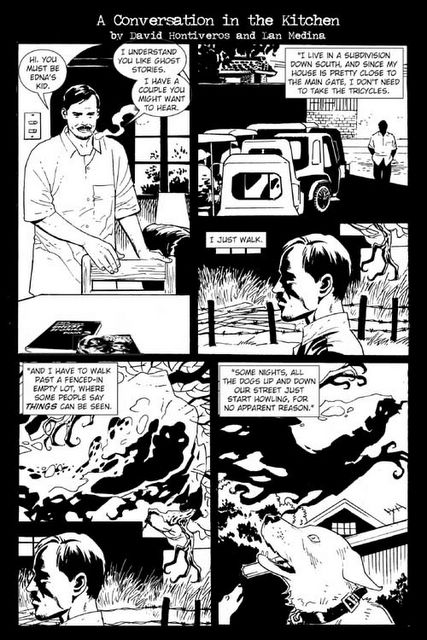
written by David Hontiveros and illustrated by Lan Medina

Read the whole 8-page strip in True Philippine Ghost Stories book 11.


Linked from: http://www.jupiterrising.blogspot.com/

Tuesday, August 24, 2004

.

Kaming Mga Seroks
by David Hontiveros

You know me on the boards as “Jim Crack,” but my real name is Peque.

I’m a basurero. A garbage collector in a small south-east Asian
archipelago called the Philippines. You may recall my country with these key words: Ferdinand Marcos and People Power.

I’m also a seroks; what’s known in the West as a dupe.

Where to start?

Read the rest of the story at:
http://www.geocities.com/icasocot2/hontiveros_seroks.html

Friday, August 20, 2004


‘BERTO, ON THE CORNER OF AYALA AND MAKATI AVENUE (VERSION 2.0)
By David Hontiveros

June 23, 2050.

Thursday.

Makati. Gaudy neon tiara of the painted whore that is NeoManila. Despite the apparent anatomical discrepancy, the heart of HighTown.

‘Berto stands there, at the heart of this heart, the corner of Ayala and Makati Avenue. In his melanin-adjusted skin (an aesthetic pale pink now), a fresh shave and crewcut, and decked out in fashionable barbaric chic, he feels he belongs here.

He’s at home here, this razorboy.

At home, for a job interview.

He blinks, shutter eyelids, masking crimson Matsushita implants for a mute instant. The reflected masses of Ayala Avenue disappear, then reappear, on the convex surfaces of ‘Berto’s purchased eyes. Harsh green digits flash in his lower left field of vision [17:24:02], overlaid on the scene before him, ghost numerics only he can see, with his new, high-definition vision.

Early, he thinks. Time to kill.

The jostling flocks of sararimen migrating home from the Stock Exchange Complex, an urban menagerie of synthetic silk and wool, ebb and flow around ‘Berto in the ritualized lethargy of the end of yet another tedious workday.

Above the madding Makati crowd, a thin blanket of smog hovers in the air like a smudged film of Plastick stretched tightly across the face of God. A corporate hovertransport bearing the ubiquitous logo of the San Miguel Corporation vectors towards the landing pad atop the Shangri-La, the vehicle’s reinforced glass front lit by the garish neolux of the world-famous hotel.

‘Berto watches the transport display an insectile grace as it touches down, haloes flaring off its black chrome carapace. He watches, standing at the foot of a ten-story tall adboard for The Body Shoppe, on the spot where the old PLDT building was once, back when landlines hadn’t yet become obsolete.

Blandly curious, the razorboy turns and cranes his neck, gaze turned skyward to watch the display.

The Shoppe’s proprietress, Narcissa, in a shimmering vidgown running a fractal graphic loop, looms over `Berto, nearly a hundred feet tall. Blinking fiber-optics nestle in her scalp amidst her lavender tresses. White, faceted cyberlenses gaze blankly from her perfect, painfully sculpted face, a gigantic insect’s compound eyes.

Narcissa is gorgon-like, monstrous in her elegance.

The razorboy tightens the focus of his implants, fascinated by her gargantuan lips, by the tight, almost cruel slash of them, as she speaks of the unparalleled glories of cybertechnology.

“Man is imperfect,” the digitally reproduced voice drones. (Narcissa’s faint French accent makes the chip voice sound just a little bit more human.) “At the Body Shoppe, you can reach your full potential. Desensitization is the key to opening the doors of paradise.

“We take away parts of you, yes, making you less you. But this is not dehumanization, but rather, a reconstruction into a being far better equipped to enjoy the world that surrounds him.”

`Berto smiles drily, his smirk uglier even than Narcissa’s coldly-edged gesture. Even as he wonders how much these well-dressed parasites charge for their procedures, a male game-show voice comes on-line, spouting the requisite come-on.

“At the Body Shoppe, you can choose from a wide array of first-class, vat-grown organs, or natural implants supplied by the Shoppe’s numerous, yet meticulously screened donors. We also offer the widest range of cybernetic implants of the finest local and foreign head- and bodyware in the Asian territories. Only at The Body Shoppe, located on the 14th floor, Building C, SM Metamall, EDSA.”

Narcissa appears a final time, just a flicker really, almost like a retinal afterimage, a video phantasm, her gown’s graphic display now a programmed aurora borealis trapped for perpetuity in the flat skies of ad heaven.

`Berto snorts softly, once. A derisive sound. Standing there, at the foot of this hundred foot-tall millennial Madonna who begins her spiel again-- a video uroburos eating its own pixellated tail-- the razorboy presses the internal rewind button, time-lapsing backward, tachyon-like, remembering his own remod.

In Banaue.

Down.

Down in LowTown.

There, among the narrow alleys that smelled of motor oil and piss, where metal and plastic prosthetics hung from strung-out lengths of black plastic cord, and display windows streaked with grease and spit showcased endless rows of optical implants, dead eyes in a whole spectrum of colors that stared right back at any interested parties.

There, in Banaue, `Berto had understood, instinctively, the source of all these artificial body parts.

Illegal smuggling, of course. But others, though. Others were procured by far more dubious means.

The former owners, transgressors of some law or other of the street, chopped up, with any usable parts—technological or organic—salvaged and sold at dirt-cheap prices, the rest of them left to rot in the steaming piles of refuse called Smokey Mountain.

But they were the weak. Poor fools fallen prey while slumming on the crude edges of NeoManila’s savage urban geometry. Here, in a sprawl where victims didn’t last long, where daily life was every Darwinian’s wet dream, there was no place for the weak.

‘Berto had learned that long ago, learned it living a life where mines were buried everywhere, tiny viruses waiting to be triggered. A look. A word. A gesture. In a sprawl like NeoManila, any of these could get you killed.

Being poor just made it all worse.

If it was something `Berto had promised himself years ago, it was that he would achieve escape velocity from the unfortunate circumstances of blood and chromosomes.
He’d saved up for years, `Berto had, from the odd job here and there.

Roberto Sandoval, Secman for Hire, his plascard read, in no-nonsense Arial italics.

He’d paid for his remod in crumpled, well-worn scrip, and Nic had assured him that here in Banaue, in the steaming loins of LowTown, were the best parts for the lowest prices.
Behind a steel-accordion door chained and padlocked by two heavy-duty, industrial Yales,

`Berto had allowed Nicodemus Lazaro—he of the ratty dreadlocks and scarred countenance, also considered the best medic on the black market—to take scalpel to skin and slice deeply into his humanity. To the caustic sound of the C-Brains blasting from the mastoid implants in his head, Nic headbanged to the music only he could hear, as he gave `Berto all his hard-earned money’s worth.

And it had been a lot of money, but surely not as much as if he’d gone to The Body Shoppe. (“Located on the 14th floor, Building C, SM Metamall, EDSA,” `Berto hears in his head, the particularly virulent meme already in evidence.)

He imagines it; its climate-controlled waiting room, littered with wafer-thin laptops endlessly scrolling through the latest, hippest CD magazines, ambient muzak drifting languidly from the cleverly concealed speaker system. A delicate, fragile place, sterile, where even dust seems to weigh too much to be supported.

A dead place.

But perhaps, `Berto might have resorted to such a place, if only to shed the old `Berto, to strip off the flesh lacerated and scarred by his mother’s words and silent resentments, the `Berto he’d left behind in Banaue, the one that belonged there, in Nic’s back alley clinic.

The ‘Berto that would never have been accepted in the shining streets of HighTown.
But as much as he despises HighTown though—with its shining veneer barely masking the savage civility of its populace—he also knows that this is where the real money is.

If only for that, this razorboy must learn to like HighTown, if not love it.

In truth, he hated HighTown once, hated it because it was everything he knew he was not; all he could have been, had his mother had her way.

(And here, once more, the rewind button is pressed, farther back into the temporal distance.)

Living in the shanty that teetered precariously on mounds of wet, rank garbage, flies describing wild, erratic orbits around anything that moved, that breathed, in this matricentric prison of his youth, this strange sort of heterotopia, self-contained and hermetic, a cramped jail of pain and unarticulated frustration where Mother knew best. Where Mother knew all.

A fond little loop of memory from this period: `Berto at fourteen, buzzed on rugby, watching his now-fat mother, far too old beyond her years, in an awful, plasvid duster, screaming at him to get a job and make some decent money. Through her tirade, his eyes were riveted to the archaic bit of flash animation that skittered across the duster’s crinkled surface, some Mexican telenovela star from decades back, running across a patently fake garden, being chased by her hunky, horny suitor.

He ran that loop every once in a while, when he was perversely nostalgic.

Now though, he wanted to go even further back, to visit a pre-`Berto time, to dig up and examine fossils of events he’d only ever heard about.

The Ermita hooker (and soon-to-be mother) takes it into her head one day to succumb to her long-dormant maternal instinct, seeing her wished-for child in every disposal, edible diaper ad on the tube. Militant in her new-found calling, she refuses her weekly spermicide treatment, hoping on her scores of prayer hankies, holographic El Nino, and singular, much-beloved agimat, that her American regular, a Harrison account exec named Frank, would be the unwitting father.

She doesn’t count on her pimp, Nardo—bald, greasy, obese Nardo—raping her in a drunken rage. Nine months of weekly pilgrimages to Quiapo Church later, and `Berto is born, a squawling brown monkey in his mother’s eyes.

(And here, though the advent of `Berto has come to pass, he is still not cognizant of the events in his world, so the unearthing of bones continues.)

Up till that moment in the QC free clinic, when she first lays eyes on her infant son, seeing him as a wizened and wet tumor that has finally been excised from her body, she has held out the hope that Frank’s red, white, and blue sperm would be the stronger.

She wails at her first sight of `Berto. The doctor, thinking his patient is experiencing another bout of pain, ups her dosage of sedatives, then leaves to go about his rounds
.

In the years that followed, `Berto was never allowed to forget the child he could have been. If his mother could see him now, the razorboy imagines she would approve. She would take one look at his dyed hair, his new, sparkling white teeth, his manufactured muscle tone, his baby pink skin, then sigh, knowing her son had finally arrived.

Abandoning the rewind button for the meantime, `Berto stares at a twentysomething in mirrorshades and the latest drab grey Armani. The mental image of this yumbie reaching his highrise condo unit, hooking himself up to his expensive Sega home entertainment system, and slipping in a simcart so he could temporarily be Indiana Jones or 007 (or maybe even Lara Croft, if his kinks were wired in that direction), just so he could feel good about his would-be life, makes the razorboy burst out in sudden laughter.

“There a problem?”

`Berto turns to the speaker and sees a featureless ovoid helmet atop the familiar midnight blue ensemble of AyalaSec.

In response, the razorboy flashes his left palm, displaying the barcode laser-etched onto his skin. The corpcop pulls out his reader, a hybrid of Hollywood raygun and hair dryer, a burst of crimson light shimmering as the reader is held to `Berto’s palm.

Corpcop gazes at razorboy.

“You’ve got an appointment with Sister Yana Ya Ya of the First Church of Digital Deliverance in about half an hour, Sandoval.”

If `Berto hadn’t known any better, known the corpcop was getting all this from a scrolling field of data that ran down the inside of his face mask, the razorboy would have sworn that the cop had just read his mind (or that the reader had seen all this in the lines of his palm, seeing his fate and destiny in the fine traceries of his new skin).

“Know where the Church is?”

`Berto gestures, finger pointing in the direction of the vast Greenbelt Arcology. “Just by the main entrance.”

“Sister Ya Ya doesn’t approve of tardiness. If you want to be one of her bodyguards, you’ve got to impress her first.”

The razorboy nods, mentally giving the corpcop the finger.

As `Berto abandons the recorded Narcissa-- trapped in her own self-repeating heterotopia on the adboard-- and walks down Makati Avenue, he clenches his left hand into a fist, his fingertips running over the barcode, the one most important thing in his entire existence, for it proved, in the labyrinthine bowels of the electronic beast known as The System, that he did, in fact, exist.

Before he’d had the money to purchase his code, he hadn’t existed at all, a cipher in The System, a ghost in the machine. Without an identity, his flesh and bone weren’t enough to prove he was an individual who actually lived and breathed. Now, only citizens with barcodes had rights; all others were persona non grata.

`Berto had been there before, a non-being to both the government and his mother, sleeping in refuse, dining on the regurgitated left-overs of a mad society. He had been there and he was never going back.

Smiling, the razorboy reviews himself.

He’s got the look, he’s got the swagger, and the language lexicon is slotted neatly into his cortex, giving him an impeccable command of the English language.

Yes, `Berto thinks, he is in the heart of the heart of HighTown, and he has absolutely no intentions of ever leaving it again.

His smile deepening, the predatory flash of his teeth catching in the sodium lamplight, `Berto walks on, humming a tuneless song, while a light chemical rain begins to fall.

Thursday, August 22, 2002


A copy of a copy
I uploaded David's award-winning story in the Alamat e-groups FILES section. Read it and enjoy!


Thursday, August 08, 2002


David Hontiveros wins Palanca

David is the 2nd place winner of this year's Palanca Future Fiction (short story) category. His award-winning entry is entitled “Kaming Mga Seroks”, which tells the story of a future Philippines where human clones are illegally sold in the same way pirated CDs and VCDs are sold today.

David is one of the founding members of Alamat Comics and has written the comic books “Flashpoint”, “Dhampyr”, “Horus”, and “Avatar”. He has also written articles and reviews of various magazines and newspapers.


Wednesday, April 03, 2002


BOO (The Darker Saints of Cinema)
An Article in Eight Reels with Intermission
By Dave Hontiveros


Intro

Craven. Carpenter. Romero. Argento. Raimi. Cronenberg.

During the glorious, heady era of the 70’s and 80’s, these names were synonymous with horror, these were the auteurs of the gruesome and the macabre, and if you were inclined towards that end of the cinematic spectrum, these were the names of darker saints, writer-directors whose celluloid visions served to both enlighten and disturb, 24 frames per second.

But the 90’s came and went, horror donning “gentler” masks and going underground, still there, most definitely, but far subtler than the gore-soaked, blood-drenched films of the 80’s. And then of course, when American high school violence reached its most media-visible in the Littleton, Arkansas shootings, genre material like Scream and (bizarrely enough) Buffy the Vampire Slayer, became Senate hearing scapegoats.

In all of this, those of us who grew up with these horrormeisters, and somehow lost touch with the scene, could wonder, Well, where the hell are they now?

Reel One
Bursting from Canada in the mid-70’s with his chilling visions of mind/body conflict, independent revolutions of the flesh, and societal decay, Cronenberg’s most recent films were the controversial adaptation of J.G. Ballard’s auto-erotic Crash, and 1999’s study of the nature of reality (virtual and otherwise), eXistenZ. Both were excellent and unsettling pieces from cinema’s undisputed master of organic horror (once called “Canada’s King of Venereal Horror”).

To my mind, beginning from 1976’s harrowing Rabid * (which stars porn queen Marilyn Chambers, in case anyone’s interested), Cronenberg has only really disappointed me once, with his curiously drab take on M. Butterfly, with Jeremy Irons (who gave a truly stunning performance as twin gynecologists in Cronenberg’s Dead Ringers).

Currently, Cronenberg is working on something called Spider (to be scored by long-time collaborator Howard Shore, who just won the Oscar for the musical score of The Fellowship of the Ring). To the best of my knowledge, Spider is a psychological horror film, and we all know how downright disturbing Cronenberg’s forays into the mind can be (Crash and Dead Ringers instantly come to mind), so I’m anticipating this one with extreme relish.

* (I have yet to find a copy of Cronenberg’s debut feature, 1975’s They Came From Within, which is the only film of his I have not yet seen.)

Reel Two
Sam Raimi slammed his way onto the horror scene with 1983’s in-your-face exercise in extreme horror, The Evil Dead, but took up most of the ‘90’s co-producing direct-to-video sequels of his 1990 hit Darkman, as well as Hercules: The Legendary Journeys and Xena: Warrior Princess. (So, from a certain angle, one could say Raimi’s to blame for inflicting these shows upon us. As for me, I figure, they poured a heap of money into his bank account, and the truth is, an artist needs money to keep himself—and his family, if he has one—clothed and fed while he’s off chasing his muse; I may not have been a fan of either show, but I’m nonetheless happy for Raimi’s success.)

Regarding his film work, Raimi took a conscious step away from genre material with 1998’s A Simple Plan, which earned him critical acclaim as he proved himself capable of directing a film without Evil Dead zombies or a Darkman running through its scenes. (Billy Bob Thornton’s well-earned Oscar nomination for his performance in A Simple Plan was the proverbial icing on an already delectable cake.) He followed that triumph with the excellently-acted, though rather lethargic The Gift, where the always divine Cate Blanchett played a psychic pulled into the disappearance of wealthy socialite Katie Holmes.

Now, Raimi is making a sizeable splash by helming one of this year’s summer monsters, Spider-Man, which should benefit from his kinetic camera-work and the intriguing possibilities of Tobey McGuire’s first brush with the mainstream Hollywood popcorn machine.

Reel Three
Italy’s Alfred Hitchcock (or so he’s been called), Dario Argento, has been working on a relatively steady basis over the past years, though the tenor of his current work is a far cry from the technicolor phantasmagoria of 1977’s Suspiria and 1980’s Inferno. His most recent offerings were The Phantom of the Opera (an undertaking he’d first talked about in the late 70’s), and 2000’s Sleepless.

Though I feel Sleepless is the better of the two, it still seems a pale echo of Argento’s past films. The train and nightclub murders are tame compared to the classic Argento setpiece of sustained stalking, culminating in a violent flurry of bloodletting (setpieces apparently inherited and given a boost of Hollywood adrenaline by Kevin Williamson and Wes Craven in the first two Scream films). The dazzling, bravura camerawork, most eivdent in ‘87’s Opera, is gone as well (also apparently inherited, this time by David Fincher and his trusty computer, in Fight Club and this year’s Panic Room). It’s strange that Sleepless looks so bland, since it was shot by the Oscar-winning cinematographer, Ronnie Taylor, who also shot Opera.

On the plus side, there is still the almost reflexive self-reference (characters’ attitudes towards their fictional creations mirror Argento’s towards his own characters—as in Tenebrae—again brushing against the misogynistic label the director has been tagged with, just as Hitchcock has). There is also a shadow of the “animal trilogy” (Argento’s first three films, The Bird with the Crystal Plumage, Cat O’Nine Tails, and Four Flies on Gray Velvet—1969 to 1971) in the nursery rhyme central to the Sleepless murders (a rhyme written by Argento’s daughter, Asia).

On the whole though, Argento’s latest is a passably involving thriller with thematic continuity to the rest of his body of work, but is ultimately burdened by a naggingly unsatisfying climax, and the shades of Argento past.

Reel Four
Humble recommendations: Clearly, David Cronenberg and Sam Raimi are still on their game, so there is nothing I might have to say to better their already exceptional work.

Cronenberg has continued to study and scrutinize his by-now familiar obsessions in his impressive body of work, while Raimi was garnered critical acclaim outside the genre and currently courts the spotlight of the Hollywood maintream. (Cronenberg’s various critical accollades, particularly for his stunning 1986 remake of The Fly, are still firmly grounded in the boundaries of the genre, even as they transcend those self-same boundaries.)

And while Dario Argento displays echoes of his past work in Sleepless, it basicalle treads the same ground of the madnesses of killers and the faceless frailty of victims. Unlike Cronenberg, who has consistently managed to apply his recurring themes, his personal predilections in different cinematic and narrative contexts, Argento has gone from film to film travelling the same labyrinth of the insane he first mapped in the “animal trilogy,” merely taking different routes to arrive at its bloodied center. And though it would be interesting to see Argento return to his former gore-soaked glories, I’m not sure the current social atmosphere would appreciate his operatic cinema of violence.

But as you so insightfully pointd out to us in Opera, Signore Argento, we are compelled to gaze upon your crimson visions; the voyeuristic impulse is already there. So we are with you; we will always be with you, in the black, waiting, breathless, for the truths that only the dark can tell.

Intermission
In the cool dark of the theater, a spear of light stabs through the black, illuminating a screen, casting images upon its white plane. There are certain films though, whose lights cast another sort of darkness onto the screen, blacker, more disturbing than the dark that surrounds you.

Reel Five
Alternately scorned and praised for the relentless savagery of his early work on Last House on the Left (1972) and 1977’s The Hills Have Eyes (for which he was described as “a director making a serious attempt at social criticism within the horror genre”), Wes Craven hit a career high in 1984 with A Nightmare on Elm Street, which introduced to pop culture the horror icon Freddy Krueger, he of the burned counternance and razorblade glove.

Unfortunately, Craven wandered rather aimlessly afterwards (for which he was, in turn, described as “a real if not always successful artist”). With ho-hum entries like 1988’s The Serpent and the Rainbow and unmitigated dreck like Deadly Friend (1986) in the interim, it wasn’t until 1996’s post-modern paean to the slasher film, Scream, and the following year’s Scream 2, that Craven hit that perfect pitch once more. (The dismal Scream 3 is best forgotten, save perhaps for Parker Posey’s hilarious turn as the Gale Weathers of Stab 3, the film’s meta-movie.) Craven also directed the Meryl Streep-starrer Music from the Heart, which bagged her an Oscar nomination but apparently did nothing for Craven’s reputation beyond the horror field.

Reel Six
George Romero (whose name will be forever associated with the word “zombie,” having been responsible for the Dead trilogy, 1968’s Night of the Living Dead, 1979’s Dawn of the Dead—co-written with Dario Argento—and 1985’s Day of the Dead) wasn’t very visible in the 90’s. He actually pointed to the box-office success of Scream as the reason why Hollywood became interested once more in what horror—and by extension, he—had to offer cinema.

He popped up in 2000 with Bruiser, a story closer to the psychological terrain he explored in 1988’s Monkey Shines, and his adaptation of Stephen King’s The Dark Half (1991). In Bruiser, we have a virtually invisible man (played by Jason Flemyng of Lock, Stock and Two Smoking Barrels, The Red Violin, and From Hell) stepped on by nearly everybody, who is liberated by a featureless mask that he wakes up wearing one morning, and finds he can’t take off.

There is a lot of metaphor in this movie; the metaphor is so thick, you’d need a cleaver to work through it. Which is not bad in itself, mind you. Anyone who knows me is well aware I am enamored of the metaphor. But you also need to tell a good story, and sadly, Bruiser just doesn’t make that grade.

Flemyng’s character doesn’t suitably convey the Everyman aspect which he should (unlike, say, Edward Norton’s nameless Narrator in the astounding Fight Club), nor the invisibility of the anonymous (as with Christian Bale’s Patrick Bateman in the wry ‘80’s satire, American Psycho). Which is not to fault Flemyng, since I feel the main problem lies in Romero’s script, rife as it is with annoying stereotypes (Flemyng’s boorish boss and bitchy wife come to mind) and predictable plot turns (guess who swindled the poor schmuck out of all that money).

And though Romero’s name was floated during the build-up to the filming of the Playstation hit, Resident Evil, that film eventually landed in the lap of Paul Anderson, director of (gasp!) Mortal Kombat. Sad, since as you may recall, Romero = zombie.
Oh well.

Reel Seven
John Carpenter, meanwhile…

Let’s see. 1978’s Halloween remains one of the best of the slasher genre (it did, after all, spark off the trend); his adaptation of John W. Campbell’s “Who Goes There?” (1982’s The Thing) remains one of the best science-fiction films ever made, with physical on-set make-up effects that are still eye-popping and jaw-dropping after two decades; 1987’s Prince of Darkness is officially the last horror movie that genuinely scared me.**

So, yeah, he rated once. He rated big time. But what has he done lately? Vampires? Ghosts of Mars?! (Where Clea Duvall and Jason Statham are just wasted, by the way.) Good God! There isn’t anything in these two sad and sorry excuses for films that we haven’t seen him do before. Creative fatigue is one thing, but this…. This is creative coma!

Look, the man once said, “… I went on and made other films and always thought, `Maybe this is the film where I’ll be taken seriously and wind up in a magazine like Film Comment.’” With Vampires? With Ghosts of friggin’ Mars ?! Not likely!

By now, one must surely sense the vehemence, and I’m truly sorry, Mr. Carpenter, but the new stuff is just tired and isn’t terribly interesting. In two words: it sucks. (And there. The greatest tragedy. I’ve fallen into hip monosyllables.)

** (Which is not to say there haven’t been any good horror movies since 1987; hell, there’ve been great horror movies since then. There just haven’t been scare-you-silly-so-you-sleep-with-the-lights-on sort of horror movies in the past fifteen years, at least not for me.)

Reel Eight
Humble recommendations: Despite Wes Craven’s success with the first two Scream films, the collapse of the third cements the fact that Kevin Williamson’s sly scripting had a significant role in what made these movies work. (The third Scream was scripted by Ehren Krueger, also responsible for the flawed Arlington Road.) Craven’s last film as writer-director was 1994’s Wes Craven’s New Nightmare, a gutsy, but horribly bungled attempt at post-modern horror. From the Scream example, it seems what Craven needs are solid, ingeniuous scripts to galvanize his directorial skills. (Of course, Craven has recently turned his attentions to writing, with his debut novel Fountain Society. What that bodes for his film work is unknown to this writer at this time.)

And George Romero, all kidding aside, does not need shambling, brain-eating zombies on set to make interesting films. Monkey Shines was a taut, disturbing movie, and his E.C. horror comic tribute Creepshow, was a blast (though that did have some walking corpses in there too). Like Craven, I just feel that Romero needs stronger, tighter scripts to work on.

Now, John Carpenter’s particularly troublesome. Who am I to presume to say, If you’re just gonna make crap, then don’t make anything at all? I suppose the problem is, when you’ve seen the glories of an artist’s peaks, it makes it that much harder to view the valleys. But, like I told Signore Argento last time, Mr. Carpenter, I’ll persevere, as I can only hope you will, and pray that the next time we meet in the cool dark, the flickering beam will illuminate those dark, towering heights I so fondly remember.

Outro
But you can be sure that when the screaming starts, and when the bloodletting commences, and when the axes descend toward human necks, and when hideous, stomach-wrenching alien creatures slither through gooey fluids to claim our souls, I shall be there.


Somewhere on the periphery of the shadows.
Scribbling notes.
Tallying bloody body counts.
Observing socially relevant issues.
And loving every bloody moment of it.
-- John Stanley
“The Career That Dripped With Gore”


Incidental note: of the half dozen horrormeisters we’ve looked at in Boo, three of them have adapted Stephen King: Cronenberg (1983’s The Dead Zone), Carpenter (Christine, from the same year), and Romero, who’s done the King shuffle twice (The Dark Half and 1982’s Creepshow).



Tuesday, July 17, 2001


MONA, TAKING IN WATER
David Hontiveros


Drowning Mona, ostensibly a black comedy, begins by bumping off one of its most recognizable cast members, Bette Midler (the titular Mona Dearly), and immediately kicks into gear as the apparent accident quickly proves to be anything but, and Chief Rash (Danny DeVito) plunges in to investigate.

The problem is, Mona was such a shrewish harridan, no one seems to be the least bit remorseful over her death, and the rest of the ensemble cast becomes suspect in the murder most foul.

Among the quirky characters who populate this off-kilter tale are Mona’s apparently p-whipped husband, Phil (William Fichtner), Chief Rash’s soon-to-be son-in-law, Bobby (Casey Affleck, in a dirty blond ‘do), the Chief’s daughter, Ellen (Neve Campbell), and the waitress with a secret, Rona (Jamie Lee Curtis).

Perhaps the best part about Drowning Mona is the obvious fun the performers have with their less-than-likeable characters. Its shortcomings though, lie in its script (written by Peter Steinfeld). Lacking the over-the-top viciousness of Very Bad Things, Mona depends on its characters to keep the story interesting. But, though the performances are notable, the characters, as they are written, aren’t as engaging as they should be. (I can’t help but look back at last year’s Cookie’s Fortune, which not only had a respectable ensemble including Glenn Close and Julianne Moore, but the characters, as they were written, were also intriguing and involving.)

The film isn’t too much of a whodunnit either, as the identity of the culprit is rather transparent, and the eleventh hour twist doesn’t do much but muddle up the proceedings.

The most interesting portions of the film are quite possibly the characters’ recollections of Mona Dearly, where we occasionally see the same event from different points of view. It is also a noteworthy point that the only sympathetic image we see of Mona is from the Chief’s memories. Though we do see that Mona is also human after all, this singular instance is hardly enough for us to reverse our abhorrence for Mona, thus, though it serves to reinforce the police chief’s utter neutrality towards Mona, the memory itself becomes a curiosity that rudely stands out from the others.

Making the most of the wacky goings-on are Fichtner (whom most may remember as the sexually questionable cop from Go) and Curtis, De Vito not given much to do other than run around and ask questions. The younger Affleck (who appeared with big brother Ben in Good Will Hunting and 200 Cigarettes) also gamely gets into character as the much put-upon Bobby, though Campbell isn’t quite as successful, as she struggles with the accent she adopts for Ellen.

And Midler, as the film’s centerpiece, is pinpoint perfect as the absolutely horrid Mona Dearly, whose death comes as a welcome surprise to all and sundry.

An agreeable hour and a half of entertainment, Drowning Mona is fair viewing, so long as you don’t expect too much and don’t look too deeply for substance.